Dynamic Rate Sheets
- Scales output
- Saves money
- Frees designers
- Workflow Automation
- F&G ·
Rebuilt a slow, manual, error-prone production process into a self-service system that generates thousands of compliant rate sheets in minutes — without adding headcount.
All projectsAt a glance
- Rate sheet production time
- 98% faster
- Product/channel combinations, zero manual setup
- 13,125
- Sales opportunity at stake in a 5-day rate-increase delay (actuarial estimate)
- $50M
- Expected earnings savings on rate decreases (actuarial estimate)
- $350K
- Designer capacity reclaimed
- 20–25% /mo
- Headcount added to automate rate sheets
- 0
The challenge
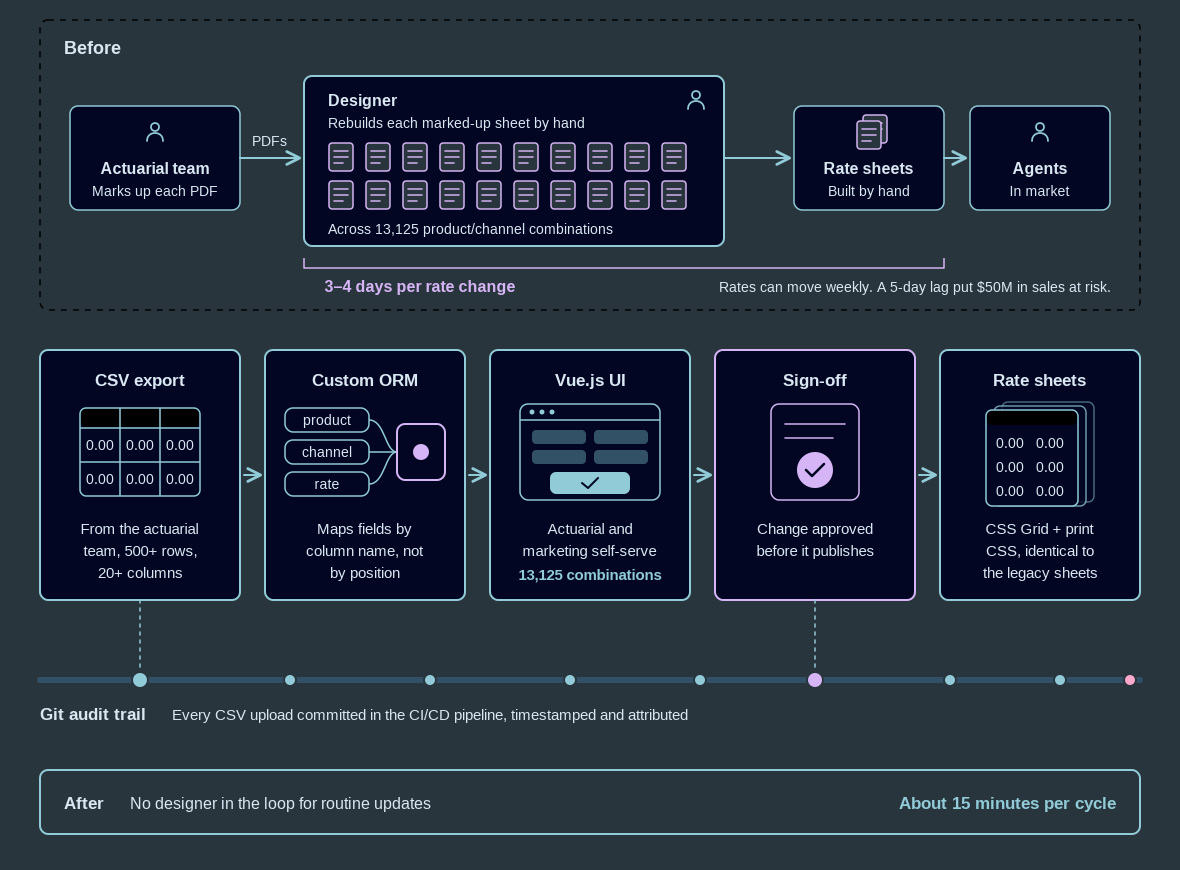
F&G produces rate sheets for its annuity and life insurance products — documents that have to reflect current rates across every product and distribution channel combination, a matrix of 13,125 possibilities. Every update meant a designer manually rebuilding sheets by hand: a 3–4 day cycle for a single rate change, in an industry where rates can move weekly. The process ate a meaningful chunk of a designer's month and left little room for error in a heavily regulated environment where every change needs to be traceable.
The delay wasn't just a production cost. F&G's actuarial team estimated that a 5-day lag in getting a rate increase to market put $50M in sales opportunity at risk, and that moving rate decreases out on time carried an expected $350K in earnings savings.
The approach
Actuaries already exported rate data as CSV, so that's where the system starts. I built a custom ORM layer that reads those exports, 500+ rows and 20+ columns each, and models the rates and products by column name rather than position. When the database export changed shape, with columns reordered or new fields added, the system kept working.
On top of it sits a Vue.js interface that lets the actuarial and marketing teams generate sheets themselves, without a designer in the loop for routine updates. They pick from 21 products (across 3 product types), 5 sales channels, 5 durations, and 25 index options: 21 × 5 × 5 × 25 is the 13,125 combinations the system handles without manual setup.
CSS Grid keeps every configuration laid out cleanly, and a print stylesheet reproduces the legacy sheets exactly, so agents and distribution partners saw no difference in what they received. Every CSV upload is committed to a Git repository in the CI/CD pipeline, timestamped and attributed, which gave compliance an audit trail for free: exactly what a regulated insurer needs when a document changes.
What it meant for the team
For the design team, the biggest change wasn't speed — it was getting 20–25% of their month back. Routine rate updates no longer needed a designer at all, so the time that used to go to rebuilding sheets by hand went back to higher-value creative work. Actuarial and marketing could ship updates on their own schedule, and compliance got an audit trail built in.
“Tim has done an outstanding job building and launching the new online rates database. His technical abilities are amazing but his ability to take feedback and shape the tool into something that truly 'wows' the sales team is extraordinary.”
The results
- Production time dropped 98%, from 3–4 days to about 15 minutes per cycle.
- Rate changes no longer wait days on production — the delay F&G's actuarial team tied to $50M in sales opportunity on rate increases and $350K in expected earnings savings on rate decreases.
- The system handles all 13,125 product/channel combinations without manual configuration.
- Designers reclaimed 20–25% of their monthly capacity for higher-value work.
- Won a NOVA Award (2nd Place, MarTech) and People's Choice at NOVA, plus a CADE Award — all 2021.
What I learned
Building Git-based versioning into the core, rather than adding it afterward, turned out to be the feature that gave stakeholders the most confidence. Compliance could see exactly what changed, when, and who approved it. That's the difference between a tool and a system.
Supporting IE9 was painful, but it was what the field was using. The most technically elegant solution that nobody uses is a failure.